Posts

Showing posts with the label Professional Learning - Critically examine how my own assumptions and beliefs

Week 27 - Examine Your Cultural Context (Take Action)

Image
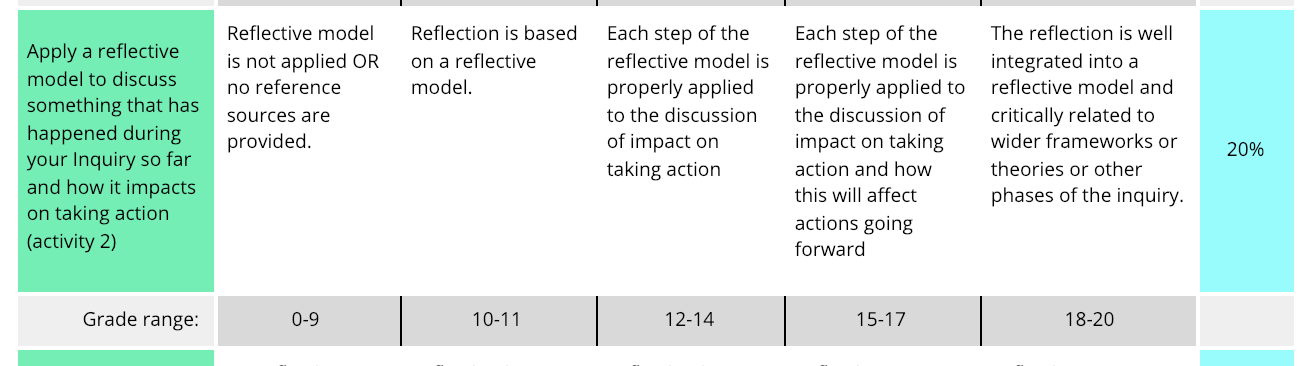
A t this stage of my inquiry, I need to reflect upon Whanaungatanga (Building relationships) specifically my interactions and communication with parents/caregivers and whanau. I plan to use Rolfe’s Model of Reflection along with the Culturally Responsive Practice for Maori Scale (CRPMS) (Asil, 2017) as the framework for my reflection. S tep 1 - W hat N ew Zealand has been identified as having one of the widest spreads of student achievement within schools which has led to Maori students being identified by the Ministry of Education as a “priority learner group”. (Asil, 2017) R ussell Bishop (2012), explains that Maori student underachievement was originally thought to be some kind of deficit in Maori people themselves. However, there is ample evidence that Maori are just as capable of being educated as other populations. Agentic teachers are the key to making a difference. According to Bishop and Berryman (2009) “they believe that all of their students can ach...

Week 26 - Reflect on your inquiry (Take Action)

Image
T his weeks reflection on my teaching practice has shown me that although I frequently reflect with my collaborative teaching partner I rarely put pen to paper and formalize the reflections.  Although we talk every day about what is happening with our students, it is only when we are writing up our Teaching as Inquiry notes for our appraisal meetings that we fully engage in research and written reflection. S o for this week's reflections, I will be using Rolfe’s Model of Reflection (Otago Polytechnic, n.d.). S tep 1 - W hat D uring the first week of term I collected baseline data, collated the results, found an area for development and selected my target students. I discovered that multiplication was an area that my target students needed explicit teaching in. So as part of the Take Action phase of the Spiral of Inquiry (Kaser, L. & J. Halbert., 2017) I set up four activities for my groups to rotate around. ( Take Action - Teaching Plan ) D uring e...

WEEK 26 - Reflect on Your Inquiry (Take Action) - Notes

Image
Gibbs Cycle of Reflection - from video Challenge you, your knowledge and your values Describe briefly - key facts only - don’t waste word count Feelings - what influenced them? Did they change during the event? Did they affect your actions? Evaluation - Your judgments at the time, what contributed to them? How do you feel about them now? Try to stand back and look at the bigger picture Analysis - start looking at the experience in depth and focus on vital aspects - were there key issues that affected something or someone? Eg lack of knowledge, communication or time management? What was the issue? What should have happened? Are there theories to understand the situation and improve next time? Examine all the influencing factors and discover ways to improve. Conclusions - Complete the key points learned through reflective practice and what to improve next time. identify any training needs or skills which could be developed further - this will inform your action plan ...

Mind Lab - Week 22 - Consider Your Context (Learn)

Image
PROFESSIONAL LEARNING Critically examine how my own assumptions and beliefs, including cultural beliefs, impact on practice and the achievement of learners with different abilities and needs, backgrounds, genders, identities, languages, and cultures. PROFESSIONAL RELATIONSHIPS Engage in reciprocal, collaborative learning-focused relationships with: – learners, families and whānau – teaching colleagues, support staff and other professionals – agencies, groups and individuals in the community Research Ethics The Key Principles of Research Ethics Here are some key principles summarised from the New Zealand Association for Research in Education Ethical Guidelines (NZARE, 2010) : Seek at all times to avoid harm and do good. The rights and welfare of learners, research participants, and the public should take precedence over the researcher's self-interest. Have a specific duty of care to research participants: to avoid unnecessary anxiety or harm ...